

In this guide
- Why A Dry Wall Can Still Be Wet.
- Pin Meters And Pinless Meters.
- What The Numbers Mean.
- The Dry Standard And Drying Goals.
- How To Use A Meter At Home.
- Where Moisture Hides.
- Common Moisture Meter Mistakes.
- Concrete, Tile And Stone Need Different Tests.
- Why Temperature And Humidity Change Readings.
- When To Bring In A Crew.
Why A Dry Wall Can Still Be Wet
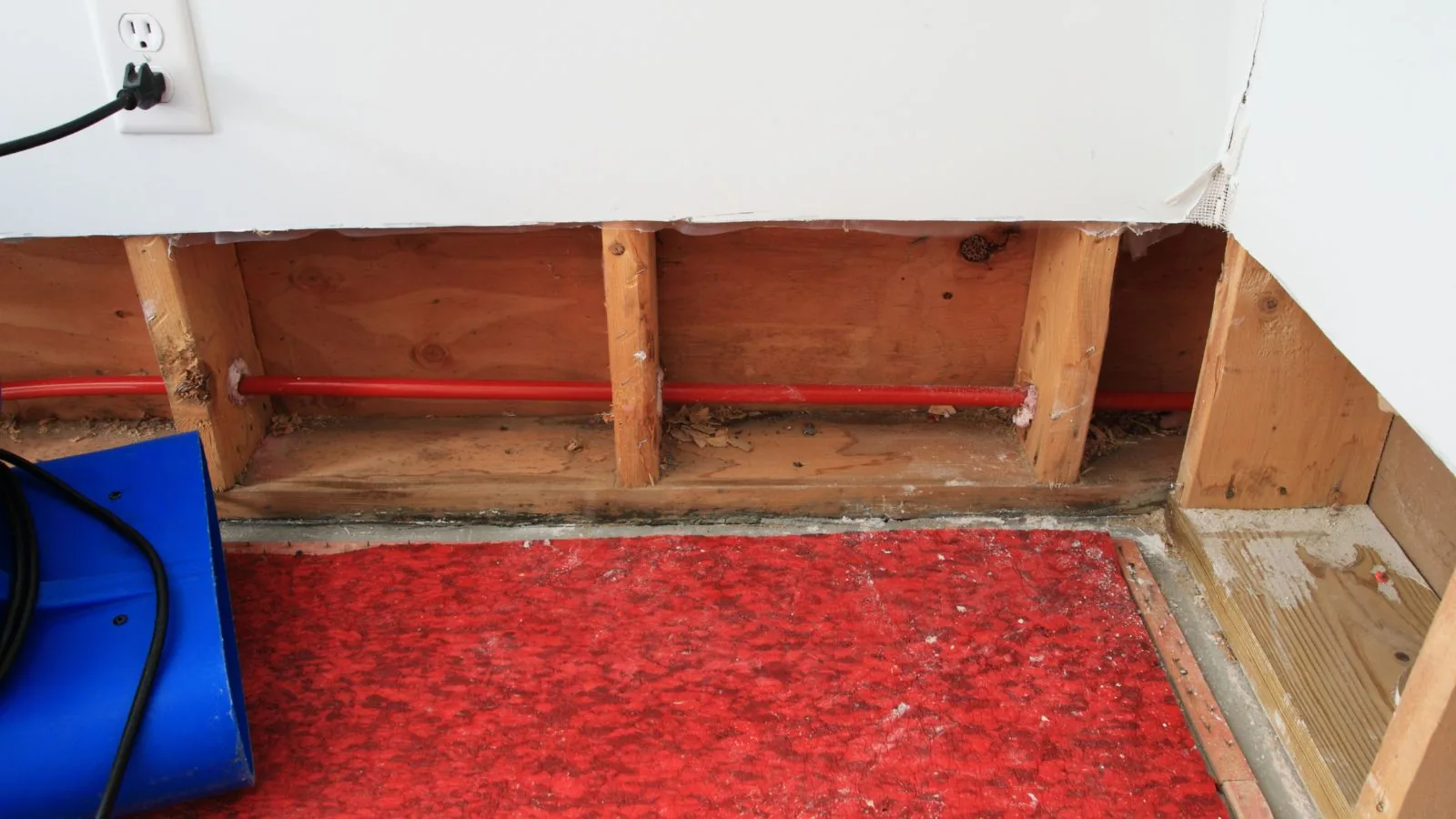
Water hides. Drywall paper can feel dry while the gypsum behind it holds moisture. Wood framing can be damp inside while the surface looks fine. A moisture meter measures what is there, which is why professionals use one before they say a structure is dry.
The meter does not decide on its own. A reading means something only when compared to a dry reference of the same material, taken from an unaffected part of the same building.
Pin Meters And Pinless Meters
| Type | How it works | Best for |
|---|---|---|
| Pin-type | Two metal pins press into the material and measure electrical resistance | Wood, baseboards, framing, specific spots. |
| Pinless | A flat sensor sends a signal into the surface and reads moisture below | Scanning drywall, floors and large areas without holes. |
| Thermal imaging camera | Shows temperature differences on surfaces | Finding cool, wet areas to check with a meter. |
| Hygrometer | Reads air temperature and humidity | Setting up and tracking drying conditions. |
Pin meters give a direct reading at a point. Pinless meters scan quickly and show where to look. Many crews use both, along with a thermal imaging camera to find suspect areas.
What The Numbers Mean
Different meters use different scales. Wood is usually read as a percentage of moisture content. Drywall is often read on a relative scale, which means the number is only comparable to other drywall readings from the same meter.
- Wood framing and flooring: compare to nearby dry wood in the same house.
- Drywall: compare to a dry wall, since many meters show a relative scale.
- Concrete: needs separate tests, since standard wood meters are not reliable on it.
- Carpet and pad: read at the subfloor and at the pad edge.
Do not trust a single number from a low-cost meter without a reference. The scale, the material and the temperature all change the result.
The Dry Standard And Drying Goals
The ANSI/IICRC S500 standard explains how to set a drying goal for each material, based on a dry reference reading. Equipment stays in place until readings reach that goal and hold steady. Surface touch is not the test.
Not sure if the house is dry?
Call the emergency line. Meter readings and a drying log are part of every job.
How To Use A Meter At Home
- Read an unaffected wall first and write down the number.
- Read the damaged wall in a grid, not just at the stain.
- Read at low, middle and high points, since water wicks upward.
- Record each number with the date and location.
- Repeat daily and watch the trend.
- Compare to the dry reference, not to a fixed number.
Where Moisture Hides
- Behind baseboards and cabinet toe-kicks.
- Under flooring edges and transitions.
- In wall cavities on the other side of a wet wall.
- In insulation above a ceiling stain.
- At window sills and door frames after storms.
A thermal imaging camera helps with these spots by showing cool patches that suggest evaporation. It does not measure moisture on its own, so a meter confirms what it shows.
Common Moisture Meter Mistakes
- Reading only the stain and not the area around it.
- Skipping a dry reference reading.
- Comparing numbers from two different meters.
- Reading while the meter sensor is dirty or wet.
- Pressing pins into finished wood without thinking about the marks.
- Trusting one reading instead of a daily trend.
Most mistakes come from treating a single number as an answer. A meter is a comparison tool. It tells you that one spot is wetter than another, and a series of readings over several days tells you whether the area is drying.
Concrete, Tile And Stone Need Different Tests
Standard wood-scale meters do not give reliable readings on concrete, tile or stone. These materials are dense, and their moisture behaves differently. Professionals use other methods for slabs, such as calcium chloride tests or sealed-sheet checks that run for a day or more.
If a slab floor feels cold or damp, or a floor covering is lifting, do not rely on a handheld wood meter. Ask a professional to test the slab before any new flooring goes down.
Why Temperature And Humidity Change Readings
Warm, dry rooms pull moisture out of materials faster than cool, damp ones. A wall that reads high on a humid winter morning may read lower on a dry afternoon without any equipment. For that reason, drying logs record the air temperature and relative humidity along with the material readings.
Why Building Age In Wilsonville Changes Readings
Wilsonville's neighborhoods were built across several decades. The city says Charbonneau, south of the Willamette, started in 1972, and the Villebois Village Concept Plan was adopted in 2003. Older plaster and newer drywall read differently, so each needs its own dry reference.
If you own a home in Old Town or Charbonneau, take reference readings from a dry wall of the same construction before you judge the damaged one.
Sources: City of Wilsonville neighborhoods page and Villebois concept plan.
When To Bring In A Crew
If readings stay high after a day or two of airflow, the structure is holding water. A crew places air movers and dehumidifiers using the readings, and logs the numbers until they reach the goal.
Homes in Sherwood and Aurora get the same method. For leaks inside walls, wall and drywall water damage repair describes what is opened and why.
Moisture Meter Questions
What is a normal moisture reading for drywall?
It depends on the meter's scale. Compare to a dry wall in the same house, since many meters show a relative number for drywall.
Can I trust a cheap moisture meter?
It can show where to look, but a single reading without a reference is unreliable. Use it to compare damaged and dry areas.
Is wood dry at the same percentage everywhere?
No. Dry wood varies with local conditions, so compare to dry wood of the same type in the same building.
Does a thermal camera measure moisture?
No. It shows temperature differences that hint at moisture. A meter confirms.
Why do pros keep drying equipment running after the surface feels dry?
Because surface touch is not the test. Readings must reach the drying goal and stay steady.